
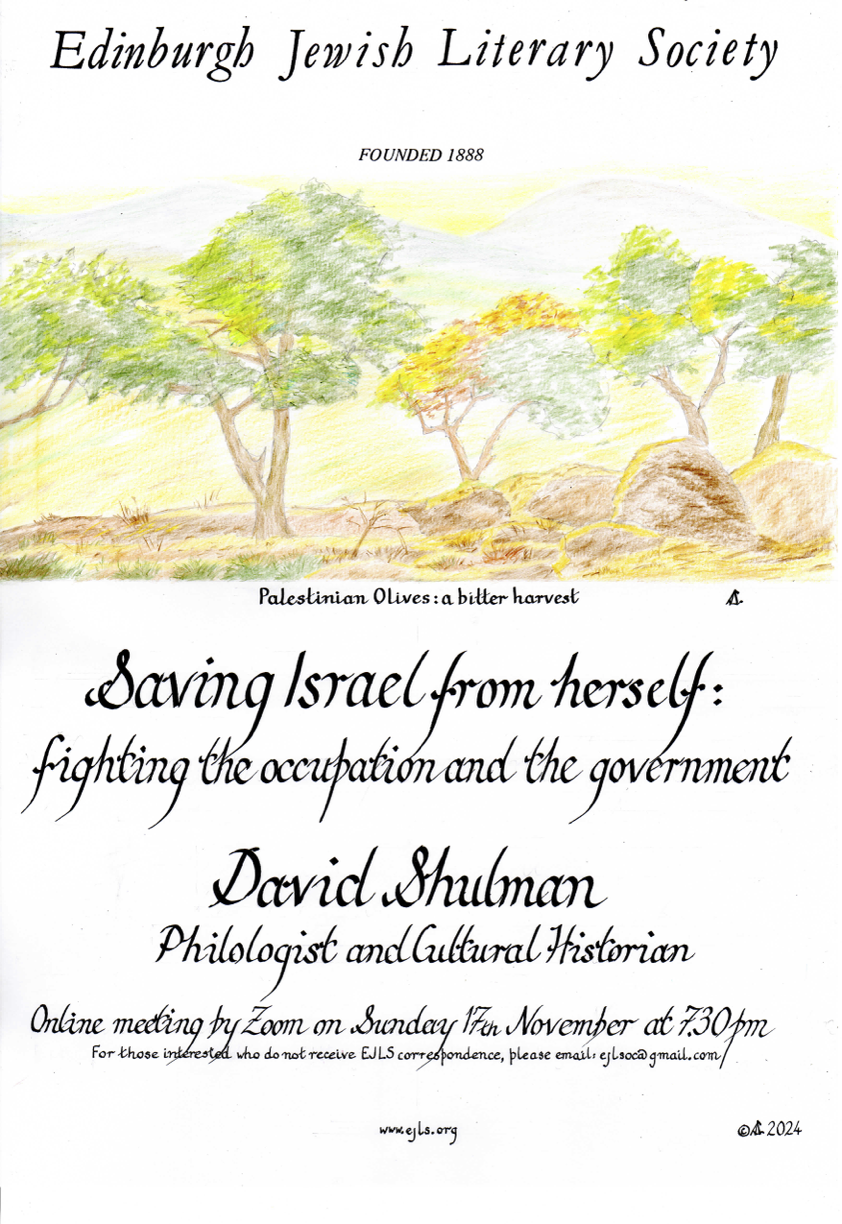
David Shulman is a philologist and cultural historian specialising in Southern India who is an Emeritus Professor at the Hebrew University in Jerusalem. He is also a long-term activist in Ta’ayush, an Israeli peace group working in the occupied Palestinian territories, and the author of several books, including Freedom and Despair, published by University of Chicago Press. He has a new book on the Palestinian communities in the South Hebron Hills and the Jordan Valley, published by Intellect Press and co-authored with the photographer Margaret Olin. It’s called The Bitter Landscapes of Palestine and offers a portrait of Palestinian lives under the Occupation.
Recording here:
Outline of Transcript
Introduction of David Shulman and His Background
- Michael Adler introduces himself as the chair of the meeting and provides an overview of David Shulman’s distinguished career.
- David Shulman’s academic background includes studying Islamic history and Arabic at the Hebrew University of Jerusalem, a PhD in the School of Oriental and African Studies, and a professorship at the Hebrew University.
- David is proficient in multiple languages and has authored over 20 books, earning him afellowship at the British Academy.
- David is also a political activist and co-founded Thai Ayush, an organization aiming to break down racism and segregation through volunteer work in the South Hebron Hills.
David Shulman’s Journey into Activism
- David Shulman describes his transition from academia to activism, starting in 2002.
- He recounts his initial experiences with Thai Ayush, a joint Palestinian-Israeli group working to protect Palestinian civilians from Israeli settlers.
- David shares a pivotal moment in January 2002 when he and his team brought blankets to Palestinian shepherds in Jimba, facing blockades and violence from settlers and soldiers.
- The experience was life-changing for David, leading him to become deeply involved in humanitarian work in the occupied territories.
Life in the South Hebron Hills and Jordan Valley
- David explains the geographical and political context of the West Bank, divided into Areas A, B, and C, with Area C under exclusive Israeli military control.
- He describes the Palestinian villages in Area C, some of which are very old and inhabited by Bedouins, and their way of life, including shepherding and small-scale farming.
- David highlights the beauty of the landscapes and the innocence of the Palestinian population, who are often targeted by Israeli settlers.
- He shows a series of photographs taken by Margaret Olin, illustrating the daily life and struggles of the Palestinian shepherds.
Challenges and Violence Faced by Palestinian Villages
- David discusses the violence and harassment faced by Palestinian villages in the South Hebron Hills and Jordan Valley, including attacks by Israeli settlers and the army.
- He recounts a specific incident where his team helped Palestinian shepherds regain access to a fertile valley, which was closed off by the army.
- Despite legal rulings in favor of the Palestinians, the army and police often side with the settlers, making it difficult for the Palestinian population to live peacefully.
- David shares a story about the village of Um al Ahmad, where the army closed off a fertile valley to Palestinian herders, but his team helped them regain access over several years.
The Impact of Illegal Outposts and the Role of Settlers
- David explains the concept of illegal outposts, which are new settlements established by settlers to expand their control over Palestinian land.
- He describes the settlers’ violent methods, including threats, attacks, and destruction of property, to drive Palestinians out of their homes.
- The settlers are often young, brainwashed individuals who see it as their mission to dispossess Palestinians from their land.
- David highlights the role of the army and police in supporting the settlers, making it nearly impossible for Palestinians to receive protection from the authorities.
The Current State of the Occupied Territories
- David discusses the worsening situation in the occupied territories since the beginning of the war a year ago, with settlers feeling emboldened to commit more violent acts.
- He mentions the rise of Itamar Ben Gvir, a far-right extremist, to the position of Minister of National Security, which has further exacerbated the situation.
- David describes the challenges faced by activists, who often face physical attacks and arrests while trying to protect Palestinian villages.
- He shares a personal story about sleeping in a Palestinian village to provide protective presence, highlighting the daily dangers faced by both activists and Palestinians.
The Case of Zanuta and the Role of the Supreme Court
- David provides a detailed account of the village of Zanuta, which was abandoned by its residents due to settler violence and the army’s failure to protect them.
- He explains how the villagers appealed to the Israeli Supreme Court, which ruled in their favor, allowing them to return to their homes.
- Despite the court’s ruling, the civil administration prevented the villagers from rebuilding, leading to their eventual expulsion.
- David describes the emotional impact of visiting Zanuta and witnessing the destruction of the village, including the wreckage of a beautiful school built with European Union funds.
Conclusion and Audience Q&A
- David concludes his talk by expressing his deep sadness and frustration over the situation in the occupied territories.
- Michael Adler opens the floor for questions from the audience, inviting them to use the chat function to ask their questions.
- The audience members express their concern and ask questions about the ongoing violence, the role of the Israeli government, and the future of the Palestinian population in the occupied territories.
- David answers the questions, providing further insights into the challenges faced by Palestinians and the need for international intervention and support.
 Edinburgh Jewish Literary Society